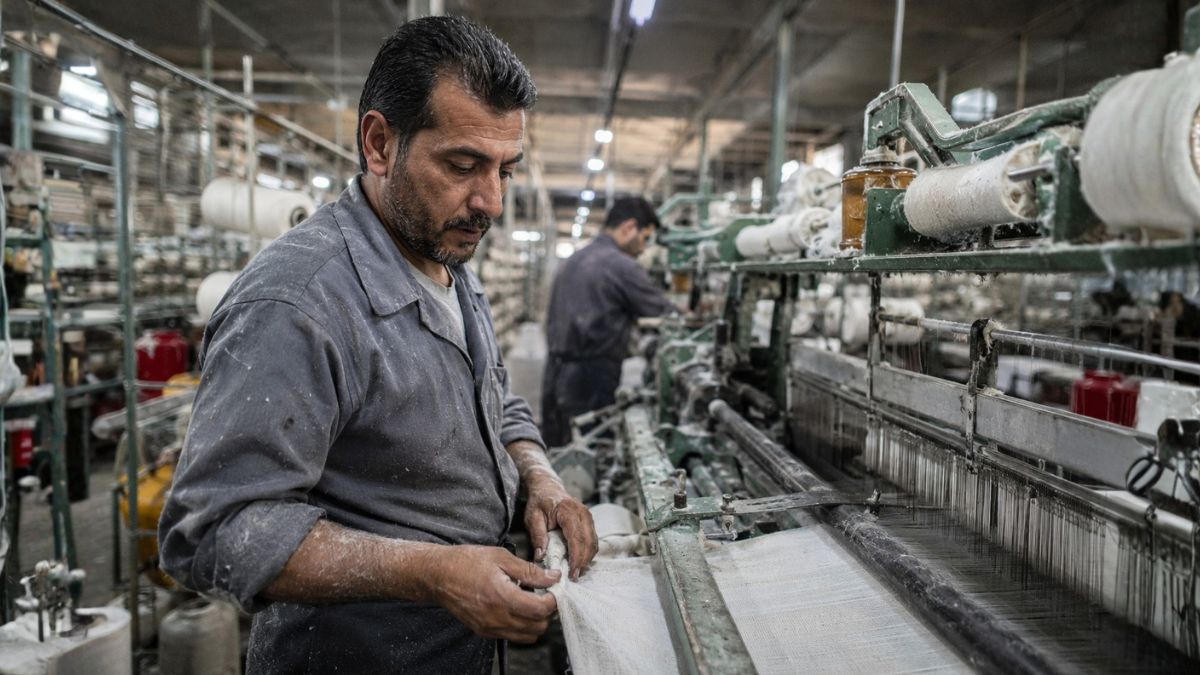
Washington Pitch on Syrian Textiles
The NASTEX international textile platform and the U.S.-Syria Business Council (USSBC) opened a Washington dialogue session on 22 May 2026, presenting American investors with a five-track plan for Syria's textile sector covering cotton, silk, wool, garment manufacturing and dedicated industrial parks.
Noor Younes, head of public relations at NASTEX, told participants the package treats Syria's textile chain as "the historic opportunity" for American capital. The session was moderated by Syrian-American lawyer Samir Sabounji, a USSBC member, with USSBC chair Jihad Selkini and a group of American investors in attendance.
$785 Million Industrial Park Package
Within the industrial-park track, three named projects were costed at a combined $785 million. "Smart Clusters," a smart-manufacturing zone, carries the largest tag at $700 million and is described as scalable to ten industrial areas. "Smart Land Furniture" would cover 19 hectares of furniture plants for an estimated $50 million, and "Smart Land Wool" envisions $35 million across 15 hectares of wool-processing facilities. The Growfast accelerator is named as a development partner on the parks.
The platform framed each unit as an independent investment, offering partnership, greenfield or phased-capital structures.
Cotton and Wool by the Numbers
NASTEX paired the industrial-park pitch with raw-materials figures. The cotton segment was costed at $32 million on roughly 49,246 hectares of land, of which more than 23,400 hectares are described as available for investment expansion, with average yield of 2,777 kilograms per hectare. The wool segment cited 20.3 million sheep and annual output near 23,142 tons, with a market value estimated at $49.5 million.
Younes argued the value chain "is ready for reactivation," citing steady Gulf demand for shemaghs, robes and abayas as a stable export base for finished Syrian goods.
Wider Reengagement Track
The Washington session followed an April 2026 panel at the Middle East Institute, where Finance Minister Mohammed Yasser Barneh and Central Bank Governor Abdul Qader al-Hosriyah met American and Syrian business figures alongside USSBC executive director Wael al-Zayat. The earlier discussion centered on banking-sector modernization, rebuilding financial infrastructure and reconnecting Syria to global financial flows.
Barneh said the briefing covered Syria's multi-year finance ministry transition program, early signs of improved fiscal performance and continued work to update the banking sector. Both officials framed institutional trust as "the most important currency" along Syria's recovery path.