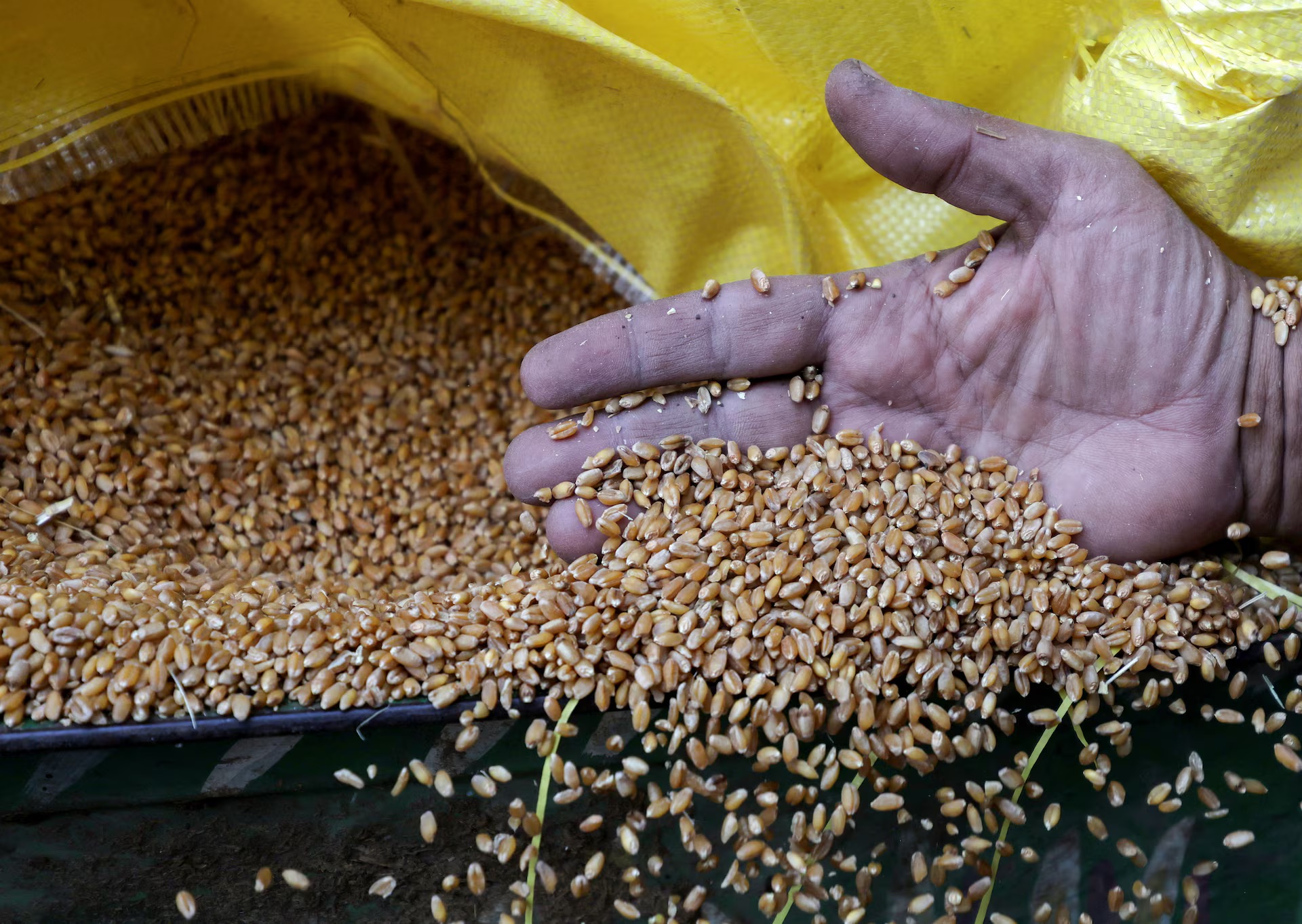
Syria’s Ministry of Economy and Industry has set the purchase price for wheat from farmers for the 2026 season at 46,000 new Syrian pounds per ton, in a move aimed at supporting agricultural production and strengthening food security.
The decision is significant for Syrian farmers because it establishes the price at which the state will buy their wheat crop. This allows growers to calculate expected returns and compare them with the costs of cultivation, harvesting, transportation, and delivery.
The pricing decision comes as the Syrian Grain Establishment launches a new electronic platform to organize wheat deliveries for the 2026 season. The platform allows farmers to create accounts, book delivery appointments in advance, and check invoices electronically, with the aim of reducing congestion at receiving centers and speeding up procedures.
The new price also comes after Syria’s currency redenomination, under which two zeros were removed from the old pound. As a result, every 100 old Syrian pounds equal one new Syrian pound. This means that 46,000 new Syrian pounds per ton is equivalent to 4.6 million old Syrian pounds, or 46 new Syrian pounds per kilogram.
Based on the latest available official exchange rate of 113 new Syrian pounds per U.S. dollar, the announced price is roughly around 400 dollars per ton, although the final value for farmers will depend on the exchange rate and payment mechanisms applied at the time of settlement.
The decision reflects the government’s attempt to manage one of Syria’s most sensitive food security files more efficiently. Wheat is not only a strategic agricultural crop, but also a key component of bread production and public food supply.
For farmers, however, the success of the decision will depend not only on the announced price, but also on the implementation process: smooth delivery, clear grading standards, timely payments, and protection from rising production and transport costs.
In conclusion, setting the wheat purchase price marks the official start of the 2026 procurement season. The real test will be whether the pricing decision and the new digital delivery system can encourage farmers to sell through official channels, increase state procurement, and support greater stability in Syria’s food security system.