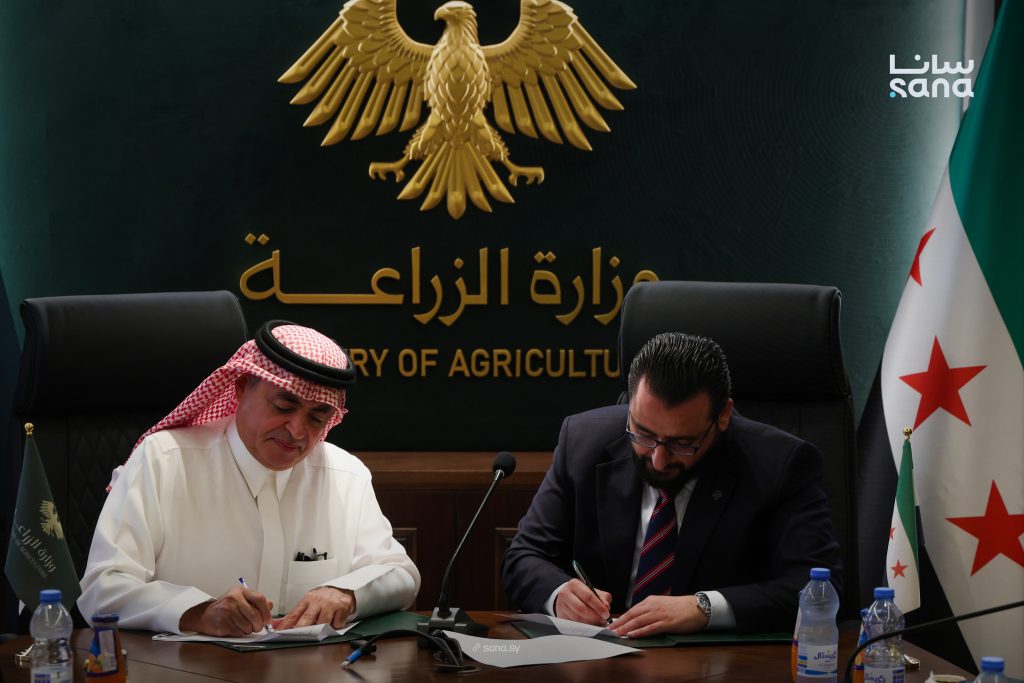
Signing in Damascus
Syria's Ministry of Agriculture and the United Saudi Feed Company signed a memorandum of understanding on Monday, 10 August 2026, at the ministry's headquarters in Damascus. It was signed by Agriculture Minister Basel al-Suwaidan and the company's board chairman, Emad Abdul Qader al-Muhaidib.
The memorandum commits the two sides to jointly study the feasibility of establishing farms and plants to produce animal feed inside Syria. At this stage it defines a shared intent to examine the project rather than a decision to build it.
Thirty Thousand Hectares
The proposed project would cover an estimated 30,000 hectares in the country's eastern region. The plan envisions farms for both feed and fodder crops, spread across the area rather than concentrated at a single production site.
Under the memorandum, those farms would rely on center-pivot and linear-move irrigation systems, operated through methods the two sides described as sustainable. The reliance on mechanized irrigation points to large, contiguous cultivation blocks rather than scattered smallholdings.
From Field to Factory
The study reaches beyond cultivation. It calls for linking the farms to plants that would process the harvest into finished animal feed, alongside manufacturing and logistics facilities to handle and move the output.
That structure outlines an integrated chain, tying field production to processing and distribution within one framework rather than treating each as a separate undertaking. The document frames domestic feed supply, from crop to finished product, as the project's central aim.
Gulf Capital, Syrian Farmland
The weight of the memorandum lies in the direction of the capital: a Gulf company examining a large-scale agricultural investment on Syrian land. The scope described covers tens of thousands of hectares tied to processing plants, an unusually broad footprint for a single proposed venture.
For now the arrangement stops short of any construction commitment. Whether it advances beyond paper will depend on the findings of the feasibility study the two sides have agreed to carry out before any ground is broken.