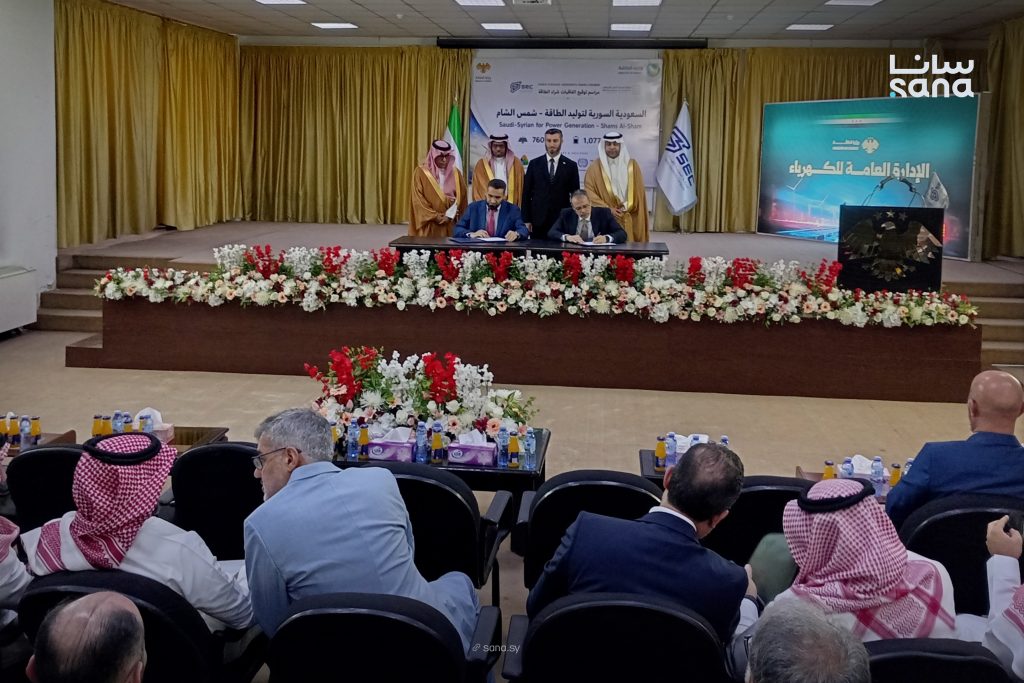
Three Solar Agreements Signed
Syria's state electricity company signed three agreements on 5 August 2026 with a Saudi contracting firm to develop power-generation projects, in a ceremony held at the company's headquarters in Damascus. The agreements center on solar energy and mark a further step in efforts to attract foreign investment into an electricity sector strained by years of conflict and chronic supply shortfalls.
Capacity and Storage
The agreements cover the construction of solar power plants in the Widyan al-Rabee area of the Damascus countryside, with a combined capacity of 760 megawatts. The projects will be paired with battery energy-storage systems rated at 1,077 megawatts.
Battery storage allows electricity generated during daylight hours to be held and released after sunset, helping to smooth the output of solar plants and support a grid that has long struggled to match supply with demand across the day.
Building on a February Accord
The signing builds on a memorandum of understanding concluded in February 2026 between the public establishment for electricity transmission and distribution and the same Saudi contractor. That earlier accord covered a 210-megawatt solar project supported by 827 megawatt-hours of battery storage.
The latest agreements represent a marked scaling-up of that initial commitment, expanding both the generating capacity and the storage envisaged, and pointing to deepening cooperation between the two sides over successive stages.
Foreign Capital in Infrastructure
The deals direct private foreign capital toward critical infrastructure at a time when authorities are working to rebuild services and stabilize the economy. Solar generation, unlike thermal plants, does not depend on imported fuel to run once installed.
Reducing reliance on fuel imports would ease pressure on the foreign currency the country spends on energy, while adding capacity that can be delivered in stages rather than all at once.
Powering the Recovery
Reliable electricity is central to reviving industry, agriculture and services. Expanding solar capacity backed by storage would add generation to a system where shortages have constrained daily life and economic activity, making stable power a prerequisite for a broader recovery.