Syria's geography, particularly in its resource-rich eastern region, is witnessing rapid field developments that may redraw the country's economic landscape after years of hardship. After more than a decade of war that depleted the country's resources—especially the oil and gas sector, which was the backbone of the economy—recent developments are breathing new life into hopes of restoring this vital sector, amid Syrian citizens' aspirations for economic improvement that would reflect on their daily lives.
Following these events, a new agreement was signed between Syrian President Ahmed al-Sharaa and the commander of the SDF, Mazloum Abdi, stipulating that the Syrian state would take over all oil fields. In light of these developments and the hopes pinned on the return of these resources to the Syrian state, we present in this analytical overview the current conditions of the most important fields, comparing their production quantities during their peak before 2011 with the difficult reality they have reached today, based on the latest documented data.
The Situation Before 2011: Self-Sufficiency and Surplus
To understand the scale of the challenge facing the energy sector today, we must return to the pre-2011 situation, when Syria achieved complete self-sufficiency. According to data from the Organization of Arab Petroleum Exporting Countries (OAPEC), Syrian production in 2011 recorded approximately 385,000 barrels per day.
This figure was not merely a statistic but translated on the ground into economic stability; Syrian refineries processed about 238,000 barrels to cover domestic needs, while the surplus was exported, generating annual revenues of nearly $3 billion.
In an analytical reading of this situation, academic and political economy researcher Dr. Abdel Moneim al-Halabi explained to "Al Jazeera Net" that managing this file involved complications stemming from the corruption of the system at the time. Out of the 400,000 barrels actually produced, only 130,000 barrels were recorded in national accounts and the general budget. As the war intensified in 2012, the curve began its sharp decline, with production reaching an average of 140,000 barrels per day—the last official statistics that revealed the size of the gap. Today, Syria faces a significant daily deficit requiring approximately 200,000 barrels to meet the minimum local needs.
Deir ez-Zor: Reclaiming the "Giants" and Awaiting the Starting Signal
The most prominent variable in the current equation comes from Deir ez-Zor Governorate. Field reports—citing the Syrian Operations Authority—confirmed the complete recapture of control over western rural Deir ez-Zor, thanks to the combined military effort and the uprising of Arab tribes. This strategic move restored state control over its largest oil and gas fields:
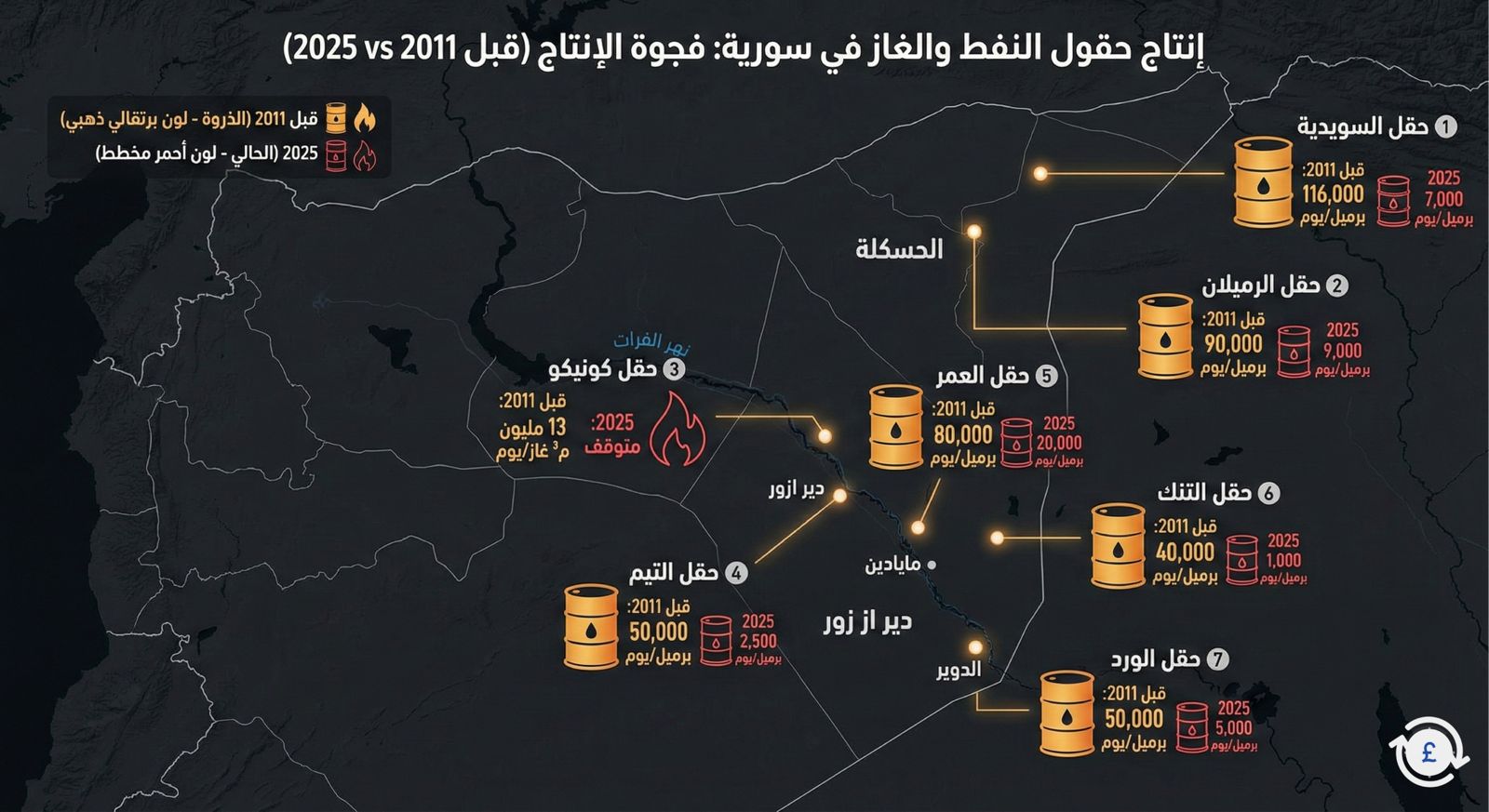
- Al-Omar Field: Considered the "crown jewel" of Syrian oil. Before 2011, it alone pumped about 80,000 barrels per day. During the war years, due to equipment damage and the inability to perform maintenance, its production dropped to only about 20,000 barrels per day. With its return to state control, the field needs tremendous efforts to restore it to its former state.
- Conoco Field: The most important gas processing plant in Syria. Before the revolution, it produced about 13 million cubic meters of gas daily, feeding power generation stations and the national grid. Currently, the field is out of operation, which explains a large part of the electrical energy crisis. Its recovery is considered a strategic "turning point" for this sector.
- Other Fields: The situation is no less tragic in the remaining fields. Al-Tanak Field saw its production collapse from 40,000 barrels to only about 1,000 barrels per day. Similarly, Al-Taym Field declined from 50,000 barrels to 2,500 barrels, and Al-Ward Field dropped from 50,000 to only 5,000 barrels.
Al-Hasakah: The Looted Treasures of the North
Moving to the far northeast in Al-Hasakah Governorate, whose resources are scheduled to return to the state under the recent agreement, the figures reveal another gap:
- Al-Suwaydiyah Field: The giant field in the Malikiyah area once produced 116,000 barrels per day alone, while current estimates indicate its production does not exceed 7,000 barrels (a decline exceeding 90%).
- Rumailan Field: The strategic neighbor that once supplied the economy with 90,000 barrels per day has seen its production shrink to only 9,000 barrels per day.
Summary of the Situation
Reclaiming the geography is a first step, but restoring production is an entirely different challenge. The figures show a massive "production gap" that requires huge investments, a long time, and technical expertise to repair what the war destroyed and rehabilitate the wells and stations. Nevertheless, extending control over Deir ez-Zor's fields along with the new agreement undoubtedly represents the cornerstone in the project to rebuild the energy sector and the beginning of hope for breaking the economic stranglehold on the country.