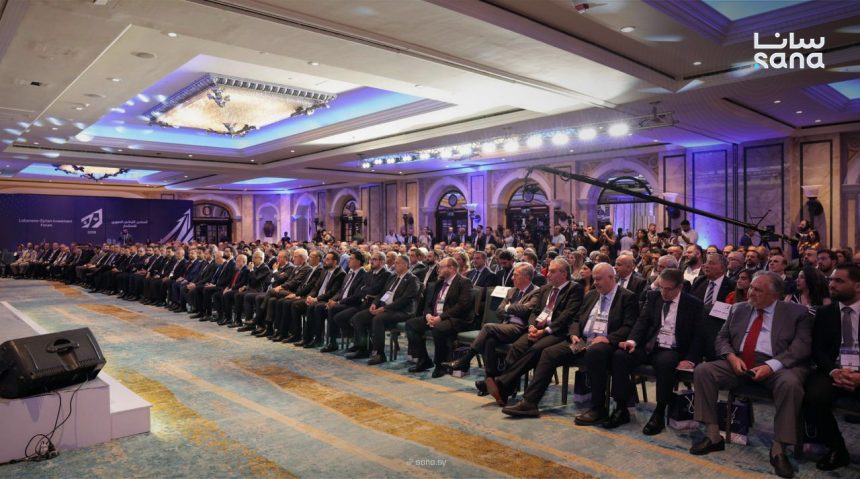
First Bilateral Forum
Syria and Lebanon held their first joint investment forum in Beirut on 23 September 2026, bringing together government ministers and more than 300 economic figures from the two countries. It was billed as the first event of its kind between the two governments, and organizers presented it as an effort to place economic relations between the neighbors on a formal, institutional footing.
The Syrian delegation included the ministers of economy and industry, tourism, health, agriculture, and transport, along with the acting Syrian ambassador to Lebanon.
Sectors in Focus
Participants identified reconstruction, infrastructure, and energy as priority areas, with further attention to agriculture, industry, tourism, transport, health, and technology. The discussions stressed pairing Lebanon's established services sector with Syria's larger domestic market and production base.
The stated goal was to build shared value chains capable of reaching Mediterranean and wider regional markets, rather than confining cooperation to direct cross-border trade. Backers argued that combining the two economies could open access to markets that neither would easily reach on its own.
Minister's Framing
The Syrian minister of economy and industry described the forum as an opportunity to move relations from ties shaped by geography to "a partnership based on will and mutual interests." He argued that durable integration would need clear institutional foundations and balanced rules.
He added that any deeper cooperation should respect the sovereignty of both states, signaling that the process would be structured through agreed frameworks rather than ad hoc arrangements between individual firms.
Scale and Limits
With participation drawn from hundreds of business owners on both sides, the forum was framed as a signal of renewed commercial interest between Damascus and Beirut after a long period in which formal cooperation had been limited.
The event centered on outlining shared priorities and goals rather than announcing specific investment values or binding commitments. That leaves the eventual scale of any capital flows dependent on follow-up negotiations and on whether the institutional frameworks discussed in Beirut are put in place.