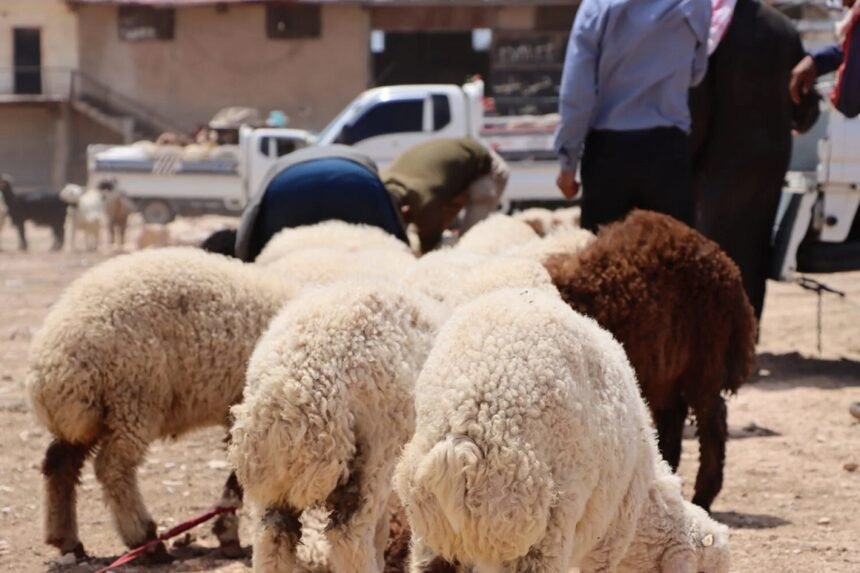
Price Doubling at Rif Damascus Market
Live lamb prices in Syria have jumped more than 100 percent in a matter of weeks ahead of Eid al-Adha, the Muslim festival of sacrifice that drives a seasonal surge in livestock demand. In the Najha market in Rif Damascus, the per-kilogram price for a live lamb climbed from 6,000 Syrian pounds (SYP) to 9,300 SYP, and traders say the upward trend has continued each week as the holiday approaches.
Supply Squeeze Across Markets
Sellers in several livestock hubs have described a near disappearance of available animals, with expectations that prices could climb further in the days ahead. Variation between governorates is described as modest, but the direction across markets has been uniformly higher heading into the holiday window.
Why Herders Are Holding Back
A trader in the Najha market, identified as Abu Kassem, cited a cluster of reinforcing pressures: herders are reluctant to release stock now, opting instead to fatten animals for higher returns, while feed costs have surged and some merchants have begun routing sacrificial animals away from local markets. He described the result as a clear gap between supply and demand that has fed directly into retail prices on the eve of the holiday.
Feed Costs Lift the Floor
Wholesale feed has risen in tandem. White hay is selling between 3,500 and 3,700 SYP per kilogram, while a ton of barley costs about 280 US dollars (USD), wheat 295 USD, lentils 490 USD and wheat bran 182 USD. Market participants expect higher base costs to keep retail meat prices elevated through the holiday window and into the post-Eid period, with limited prospect of relief as long as supply remains constrained.
A Cost-of-Living Pinch
For households preparing the customary holiday sacrifice, the price moves translate into a notably larger cash outlay than only weeks earlier. With elevated feed inputs and constrained domestic supply, lamb purchases are positioned to compete with other holiday-season spending in the run-up to Eid.