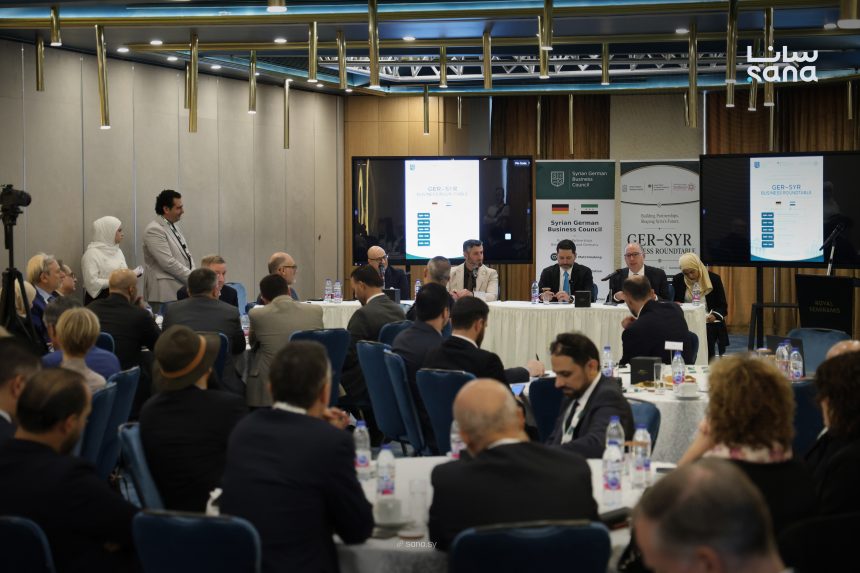
Central Bank Governor Meets German Delegation
Syria's central bank governor Muhammad Safwat Raslan and Nils Anin, deputy secretary at Germany's Federal Ministry for Economic Cooperation and Development, joined a Syrian-German business dialogue at the Semiramis Hotel in Damascus on Wednesday, 2 September 2026. The session was organised by the Syrian-German Business Council together with the German ministry, known by its German initials BMZ, and drew German diplomats and executives from Syrian and German companies.
The meeting focused on investment opportunities, obstacles to bilateral commerce, and the sectors Berlin sees as priorities inside Syria's reconstruction phase.
Talks on Payment Channels and the Pound
Raslan told the session that Germans in Syria have moved from being visitors to being partners in rebuilding the country, calling their presence an encouraging indicator. He said the exchange-rate swings the Syrian pound (SYP) has seen during the post-war period are natural and that the central bank is developing tools designed to steady the currency and clarify risk assessment for Syrian and foreign investors.
Anin said the BMZ had held direct talks with the central bank governor on opening payment channels for Syria, and that supporting investment in the country is a priority for both the German government and German companies.
A Long-Term Reconstruction Focus
Deputy Energy Minister for Water and Electricity Osama Abu Zaid said the meetings matter for the sectors most damaged by the war — water, electricity, agriculture and health — and that rehabilitation requires long-term partnerships rather than one-off contracts. He said combining German technology with Syrian technical expertise could deliver development projects across the country's governorates.
Manufacturing and Industrial Partnerships
Mazen Diruwan, head of the Syrian Industrial Chambers Union, proposed a joint manufacturing model under which parts of industrial machines would be built in Germany and completed in Syrian factories, marrying German engineering quality with Syrian production costs. Walid Sahhari, chair of the Syrian-German Business Council, said the aim of the sessions is to translate discussion into tangible projects and connect Syrian institutions with German counterparts, including the German international cooperation agency GIZ.
How the Two Countries Got Back to This Table
The Syrian-German Business Council was created by a decision from Minister of Economy and Industry Nidal Al-Shaar on 8 January 2026. Germany reopened its embassy in Damascus on 25 March 2025 after a 13-year closure, following the country's political transition on 8 December 2024. Syria in turn named a chargé d'affaires in Berlin and opened a Syrian consulate general in Bonn.