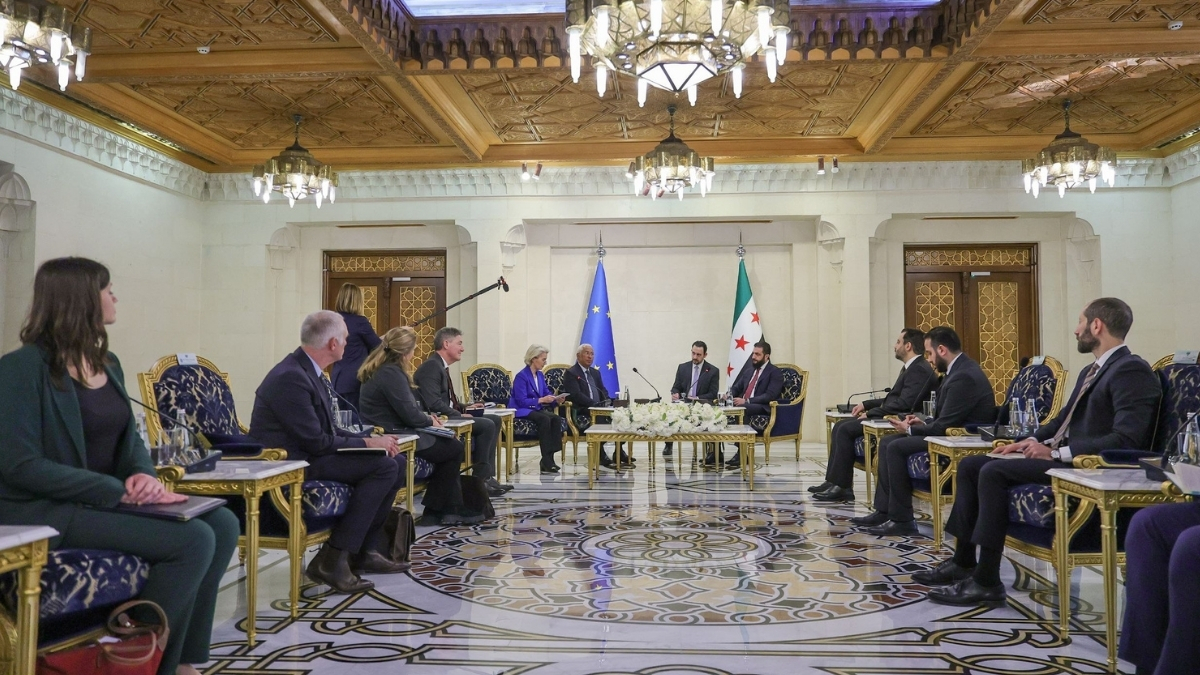
Brussels Meeting Set for May 11
The European Union and Syria will hold their first high-level political dialogue in Brussels on May 11, 2026, bringing together EU High Representative for Foreign Affairs and Security Policy Kaja Kallas and Syrian Foreign Minister Asaad al-Shaybani. The encounter marks the most senior direct political contact between the two sides since the EU partly suspended its cooperation framework with Damascus in 2011.
Both delegations are expected to use the meeting to set out red lines and openings on a range of files, from sanctions and migration to energy and regional security.
Why Europe Is Reopening the File
Brussels is being pushed toward Damascus by a converging set of interests rather than by goodwill. Curbing irregular migration, breaking up drug-trafficking networks operating from Syrian territory, and stabilising the regional security map all rank near the top of European concerns, alongside a longer-term interest in keeping Syria from becoming a launchpad for attacks on European soil.
Energy is another driver. With the bloc still searching for alternatives to Russian supply, Syria's location on prospective southern transit corridors gives Damascus a card it did not visibly hold during the war years.
What Damascus Is Looking For
For Syria, the dialogue offers a route out of the political and economic isolation that has defined relations with Brussels for more than a decade. Officials see the talks as a step that could chip away at sanctions pressure, restore lines of communication, and gradually broaden Damascus's international standing.
That ambition is constrained by the EU's "progress for progress" approach, which conditions any further opening on tangible movement on human rights, transitional justice, voluntary refugee returns, and counter-narcotics cooperation.
A Test of Intentions, Not a Reset
Analysts caution against reading the meeting as normalisation in motion. The EU lacks a fully unified foreign policy, with each member state retaining latitude on its own posture toward Damascus, which means any wider thaw will move slowly and unevenly. The session is widely framed as a test of intentions rather than a definitive reset.
Washington and the Wider Region Still Set the Ceiling
European movement on Syria remains tied to the broader Western consensus, with the United States still setting the upper bound for any economic re-engagement. The positions of Russia, Turkey, the Gulf states, and Israel will also shape how far Brussels can go, especially on energy corridors and reconstruction financing. The Brussels meeting opens a channel; whether it grows into a sustained track depends on how those external constraints evolve in the months ahead.