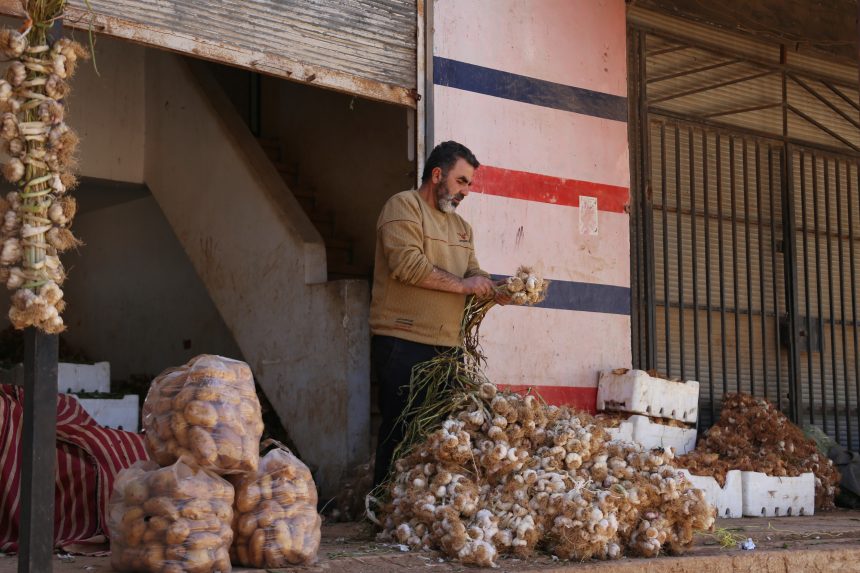
Government Halts Imports
Syria has issued a government decree barring garlic imports, a measure aimed at supporting domestic producers as the 2026 harvest reaches the market. The ban coincides with the start of the marketing season in Daraa province, a leading garlic-growing region.
Officials say the step is intended to lift local prices and reduce competition from cheaper foreign supplies. Farmers say current returns from the crop do not cover their production costs.
Harvest Tops Plan
The Daraa Agriculture Directorate estimates this year's output at about 3,000 tons of dry garlic, equivalent to roughly 10,000 tons of green garlic. Farmers planted 328 hectares against an official plan of 118 hectares — an additional 210 hectares spread across the governorate.
The overshoot leaves the directorate handling a far larger marketed volume than the season's plan envisaged.
Prices and Farmer Concerns
Green garlic is selling for between 3,500 and 6,000 Syrian pounds (SYP) per kilogram, with prices varying by bulb size. Grower Fayez al-Hussein said current prices do not cover the cost of services and inputs needed to bring the crop to market.
Marketer Saad al-Ali described trade as moving quickly because of strong daily consumption and storage demand. Producers say they are racing against the risk of further price declines as more of the crop reaches buyers in the coming weeks.
Why the Ban Matters
The ban applies an import restriction to one of Syria's key seasonal crops. For households, the move is unlikely to ease retail prices in the short term, but it gives farmers a clearer revenue path when planning next season's planting and a buffer against the cheaper foreign supplies that authorities cited as putting pressure on local prices.
It also marks another instance of Syrian authorities reaching for trade-policy tools to manage a domestic agricultural market. The immediate effect is likely to be concentrated at the farm gate, where producers stand to capture more of any price recovery, rather than at the retail counter.