Twenty Centers Set to Open
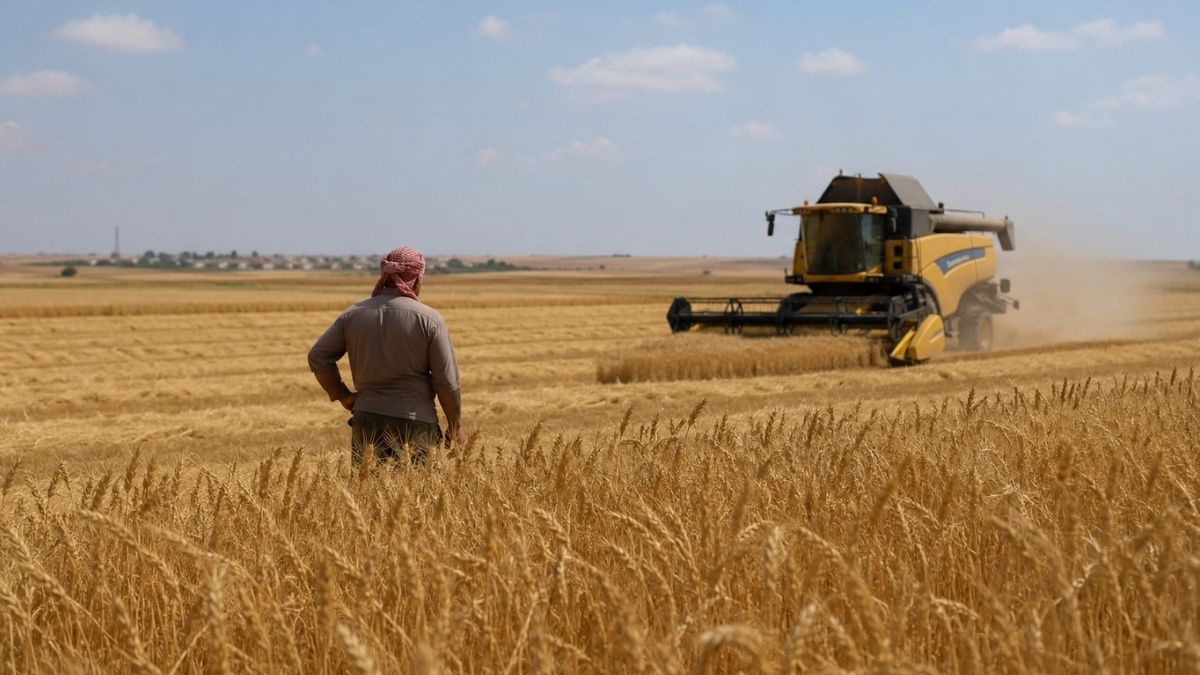
Hasaka province in northeastern Syria will open 20 grain-receiving centers on 1 June 2026 to handle this year's wheat crop, with authorities saying they have completed administrative and technical preparations to absorb the harvest. Farmers will book delivery slots through an electronic platform launched by the Ministry of Economy and the Ministry of Agriculture, after registration via local advisory units.
Three Sites in Ras al-Ayn
Three of the 20 receiving sites sit in the Ras al-Ayn area, including the Mabrouka and Sabah al-Khair centers. The Mabrouka center is expected to open about a week after the season's official start, owing to technical reasons. Officials say the broader expansion is meant to shorten transport distances for farmers in remote rural districts and ease congestion during the peak weeks of delivery.
Fire Lines Across the Plain
The provincial Emergency and Disaster Management Directorate began deploying 10 main fire-response points on 13 May 2026, then added 10 secondary points to bring the network to 20. The points cover Tel Hamis, Tel Brak, al-Yarubia, al-Shaddadi, al-Areesha, al-Hawl and Mar Kada, along with smaller villages including Sukar, Tayma, al-Darbasiya, Tel Alou, Um al-Rous and Tel al-Jayer.
Crews have already responded to fires in al-Shaddadi, Mar Kada, Tel al-Jayer, al-Areesha and Tel Hamis. Damage so far is reported as limited and confined to small areas of farmland, with rapid containment credited in part to coordination with local residents.
Pound and Bonus
The 2026 government purchase price stands at 46,000 new Syrian pounds (SYP) per ton, equivalent to roughly 330 US dollars (USD) at the prevailing exchange rate. A subsequent decree added a 9,000 SYP per-ton bonus on delivered wheat, an amount farmers described as helpful but still below what they had hoped for. Public protests followed the initial pricing decision in several Syrian cities and towns.
Farmers Weigh Costs
Several Hasaka-area farmers said the 2026 crop came in good quantity but high costs for fuel, fertilizer and irrigation eroded margins, leaving delivery to the state institution as effectively the only viable outlet. They asked for faster payment of wheat invoices after delivery and for simpler intake procedures, warning that delays compound their pre-season financial burden.
One farmer in the al-Shaddadi countryside said the priority is speed of payment so families can prepare for the next season. Others described the fire risk during harvest as a constant concern requiring rapid civilian response in the absence of full equipment coverage.