19,400 Teachers Folded Into State Payroll
The education director of Hasaka governorate, Adnan Bari, said on Saturday 23 May 2026 that about 19,400 teachers previously employed by the former Autonomous Administration's Education Authority will be confirmed as permanent civil servants on the Syrian Ministry of Education's payroll. The move would bring all educators in the northeastern province under a single national framework, ending years of parallel school systems.
Bari said verification of teacher files — checking qualifications, grade levels and school placements — was being carried out by joint committees and would be completed in "less than a week," after which staff would be appointed as permanent rather than contracted employees.
From Local Authority to National Ministry
Administrative integration of the Autonomous Administration's education staff into the Syrian ministry is "nearly complete," with employees already linked to the central system, Bari said. The total number of teachers in the governorate, combining former Autonomous Administration staff and pre-existing ministry employees, is around 33,000.
The merger follows broader changes in Hasaka since mid-January 2026, when Syrian government forces extended control over the province's eastern and southern countryside and Syrian Democratic Forces concentrated in urban centres. An end-of-January agreement to fold SDF-run institutions back into central government structures has been rolled out gradually since February.
Kurdish Curriculum Stays Until 2028
Schools across Hasaka will continue teaching the former Autonomous Administration's Kurdish-language curriculum in the 2026–2027 academic year alongside the Arabic-language state curriculum, pending the preparation of a unified national curriculum targeted for the 2027–2028 school year, Bari said.
The unified curriculum is being designed jointly by the Autonomous Administration's curriculum body and Syria's General Curriculum Commission, and will keep core sciences such as mathematics, physics and chemistry uniform while adapting history and geography to reflect the country's Kurdish, Arab, Yezidi and Christian communities.
Crumbling Buildings, 700,000 Pupils
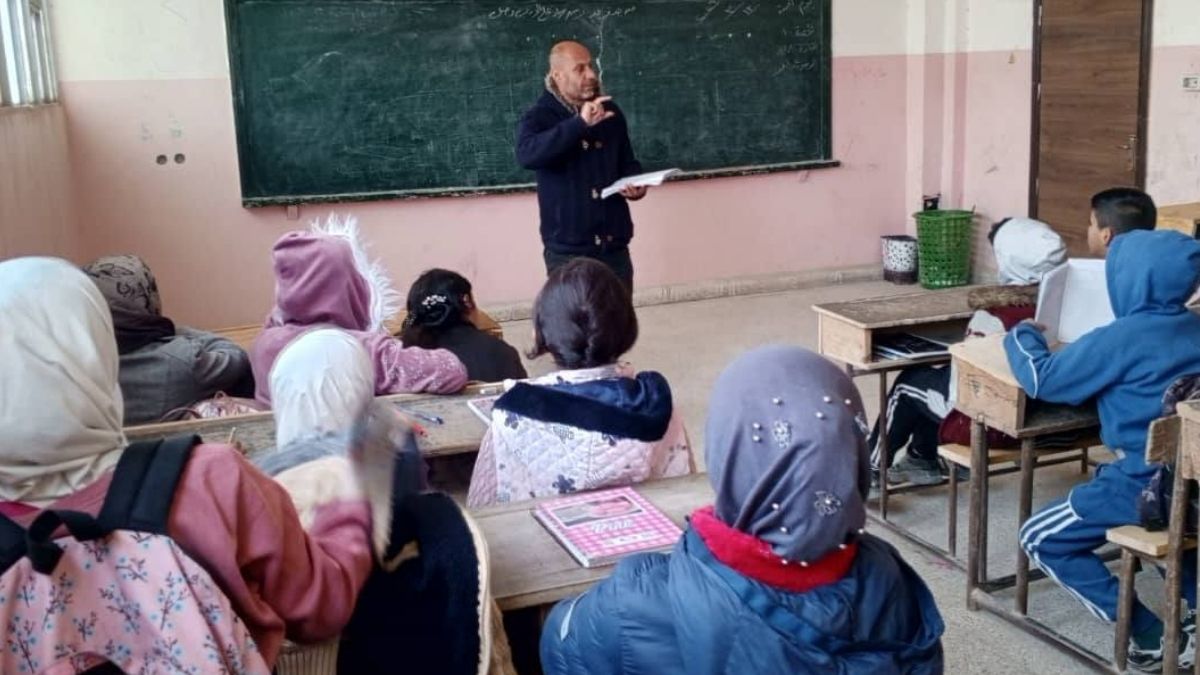
Hasaka governorate counts more than 700,000 students and over 2,000 schools, but Bari said roughly 70 percent of school buildings are in "bad condition," with some rural schools still built from mud-brick and many others damaged after being used as shelters during waves of displacement.
The directorate has requested support from international organisations to rehabilitate schools before the new academic year, with Bari noting that some students still sit on the floor in classrooms because of equipment shortages.
National Exams Expand to Six Cities
Preparations for this year's basic and secondary national exams are about 95 percent complete, with examination centres expanded beyond Hasaka and Qamishli to four additional cities — Shaddadi, Malikiya, Yarubiyah and Ras al-Ain. Around 31,000 candidates are due to sit the exams, of whom roughly 28,000 are registered through the Ministry of Education and 3,000 through the Autonomous Administration's school system.
Examination teams from the Ministry of Education in Damascus will supervise the process in coordination with the Hasaka directorate, after exam locations had been confined in previous years to Hasaka and Qamishli only.