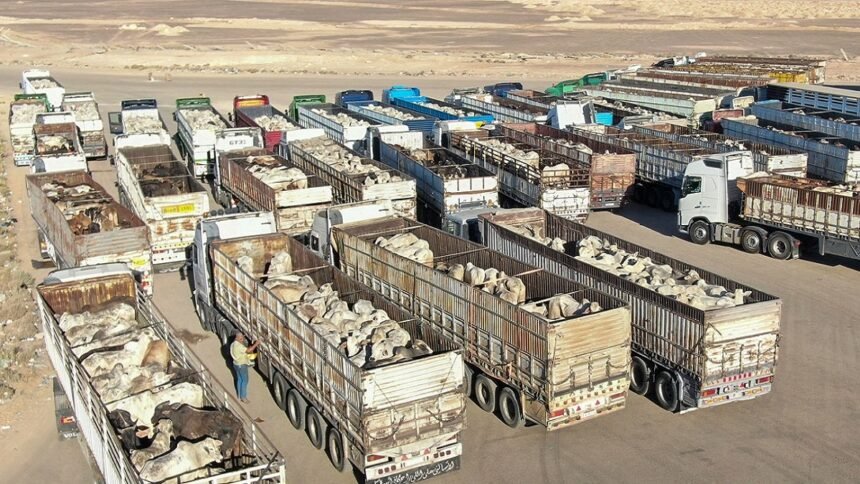
Cattle Across the Country
Roughly 11,000 calves shipped from Brazil have moved through Syria on their way to Iraq, entering at the Mediterranean port of Tartous before being transported overland to the Al-Tanf border crossing with Iraq. The transit, reported on 29 June 2026, reflects a steady rise in goods passing through Syrian territory.
From Tartous to Al-Tanf
The route runs the width of the country, from the western coast to the eastern desert frontier. Tartous serves as the entry point for the seaborne livestock, while Al-Tanf, on the border with Iraq, is the exit, making the two facilities the anchors of the corridor.
Handling live animals across that distance requires coordinated port, road, and border arrangements rather than a single point of clearance.
Scaling to Fifty Thousand
The current shipment is expected to be followed by further consignments, with the total number of cattle moving along the route projected to reach about 50,000 head in the coming period. The volume points to a recurring trade flow rather than a one-off delivery.
Because the animals are imported and bound for Iraq, the activity is pure transit trade: the cargo enters and leaves the country without being sold into the local market.
Customs at the Crossings
The Syrian General Authority for Border Crossings and Customs handled the transit procedures, facilitating the passage of the livestock from the coast to the eastern border. The agency's role places state customs infrastructure at the center of the movement and ties the traffic to official clearance rather than informal routes.
A Reviving Corridor
The growing traffic is cast as a sign of renewed confidence in Syrian crossings and ports, which are being presented as logistics hubs on regional trade routes. The transit underscores efforts to position the country as a commercial corridor linking regional ports with neighboring markets.