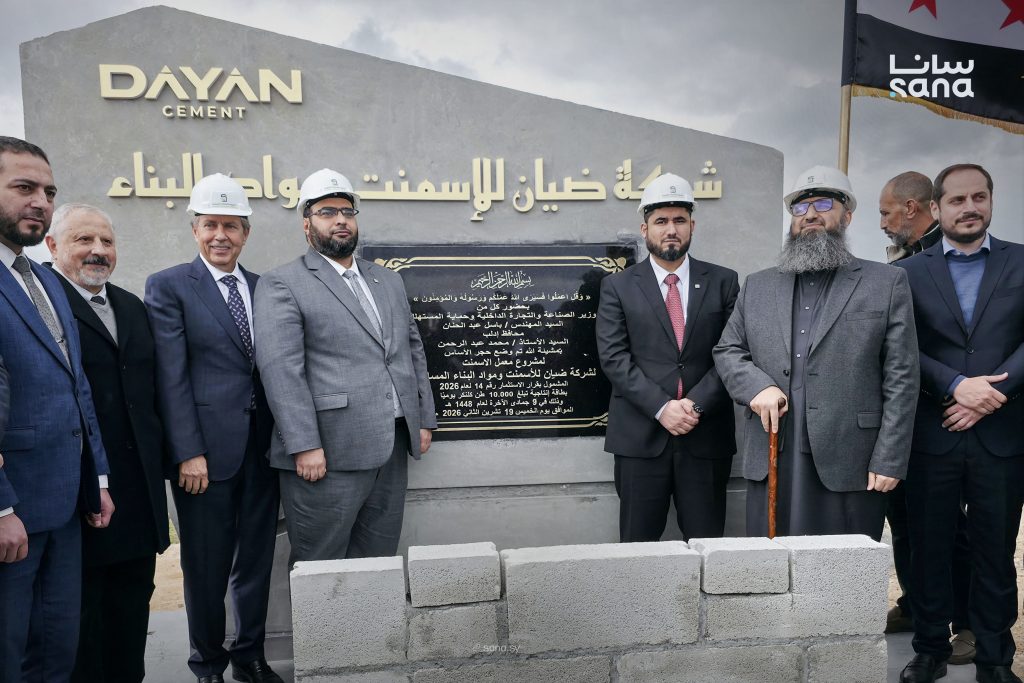
Foundation Stone in Jisr al-Shughour
The Minister of Industry and Internal Trade, Basel Abdul-Hannan, and the governor of Idlib, Mohammad Abdul-Rahman, laid the foundation stone on 19 November 2026 for a new cement plant in Jisr al-Shughour, in the Idlib countryside.
The ceremony marked the start of construction on what officials described as one of the largest ventures in the country's cement sector.
A $300 Million Investment
The project carries an estimated cost of about $300 million (USD) and is designed for a production capacity of 10,000 tons of cement a day once it enters service.
Officials said the plant would create both direct and indirect jobs, generated by the industrial, commercial and service activities expected to grow around the facility.
Built to Serve Several Provinces
The site was selected for its central position, which officials said would allow output to reach areas of demand and reconstruction more efficiently and keep supply close to where it is consumed.
The plant is expected to serve provinces within a radius of 80 to 100 kilometers, including Latakia, Idlib and Aleppo, with its reach potentially extending to Hama.
Investment Across Regions
Officials framed the venture as a step toward economic development and a more balanced spread of investment across the country's regions, rather than its concentration in a single area.
They presented the central location as an advantage that gives the project priority in distributing cement to the provinces around it.
A Material for Rebuilding
Cement is among the core inputs for reconstructing housing and infrastructure. Placing large-scale production near the zones where rebuilding is concentrated is intended to bring supply closer to the sites that will consume it as that work expands.
Rebuilding on the scale the country faces depends on steady supplies of such basic materials, a need that domestic production is positioned to help meet alongside the jobs and activity it draws in.